Research report · Industrial innovation in emerging regions
Brazilian industrial innovation is concentrated. São Paulo, the South, and a handful of other established centers absorb most investment, most talent, and most attention. The question this report was built to answer: are there regions outside that orbit that could genuinely host the next wave of industrial transformation — and what would it take?
RoleCo-author, Lead Designer, and Editor. Responsible for research synthesis, executive narrative, visual hierarchy, data visualization design, regional profiling, and final editorial review.
A strategic research report that makes the case — with data — that the next wave of industrial innovation in Brazil will not come from São Paulo or the South.
Before & after
What changed
Before
The starting point
Industrial innovation investment heavily concentrated in São Paulo and the South
No structured view of which emerging regions had real industrial and educational conditions to absorb IoT and Edge AI
Policy decisions made without comparative regional data on innovation readiness
After
What the report delivers
15 metropolitan regions ranked and profiled with consistent scoring criteria
A replicable methodology combining industrial demand, talent supply, and development need
A strategic artifact used to orient program investments and public-private partnerships
The question behind the research
Brazil invested R$38.3 billion in industrial innovation in 2023 — with the transformation sector alone accounting for 86.4% of that total. The numbers are significant. But they tell only part of the story: most of that capital flows to already-established innovation centers.
The report was commissioned within the context of the Nova Indústria Brasil program — the most comprehensive industrial policy launched by the federal government in decades. One of its core premises is that reindustrialization cannot succeed if it only deepens the existing concentration. The question became: which regions actually have the conditions to absorb technology-led transformation?
Answering that properly required more than intuition. It required a methodology.
The methodology: finding potential, not prestige
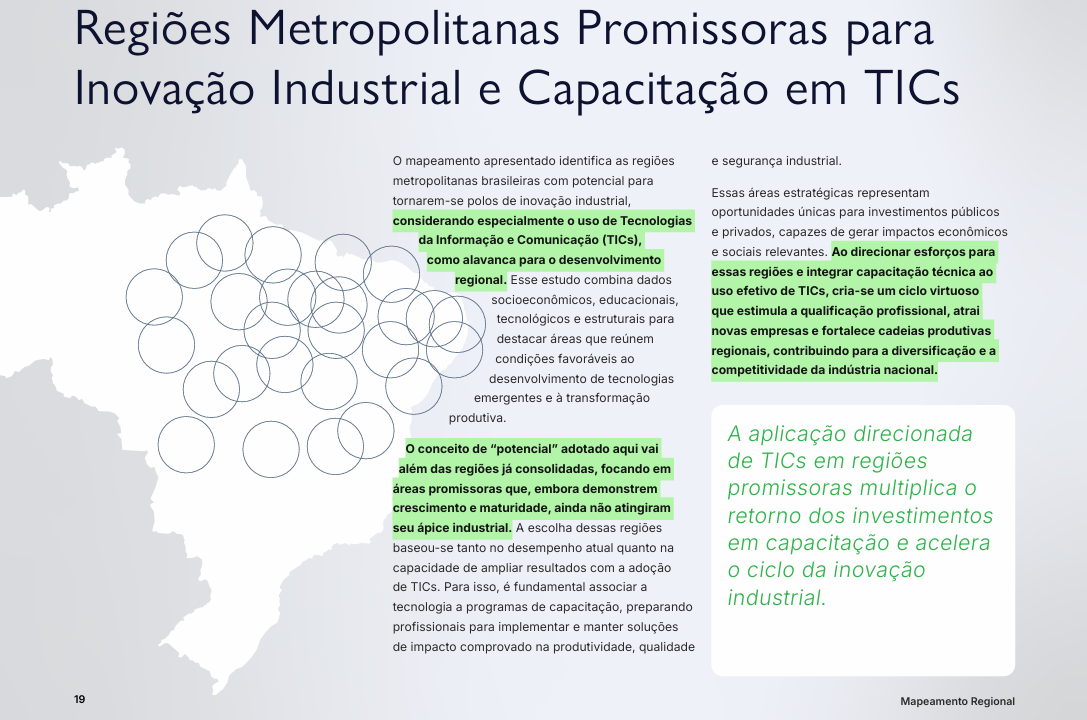
47 metropolitan regions across Brazil's North, Northeast, and Midwest were evaluated. The selection deliberately excluded the South and Southeast — not because they lack innovation, but because the objective was to find regions that are promising but not yet obvious.
The scoring model combined four dimensions: industrial demand for new talent (weighted by state-level projections from the CNI's Observatório Nacional da Indústria), number of higher education institutions with ICT programs, number of accredited Science and Technology institutions, and HDI and GDP per capita as development-need signals — prioritizing regions with more room to grow.
Regions were also subject to exclusion filters: fewer than 3 ICT higher education institutions (insufficient talent pipeline), more than 2 accredited ICTs (already established), or HDI above 0.74 (already relatively developed). The goal was to find the promising middle — regions with genuine industrial base, real educational capacity, and meaningful need for investment.
The Industry 4.0 framework: a common language for maturity
One of the structural challenges of any regional analysis is creating a shared reference point. When discussing "digital transformation" with policymakers, industrial federations, universities, and companies in the same room, the term means different things to each audience.
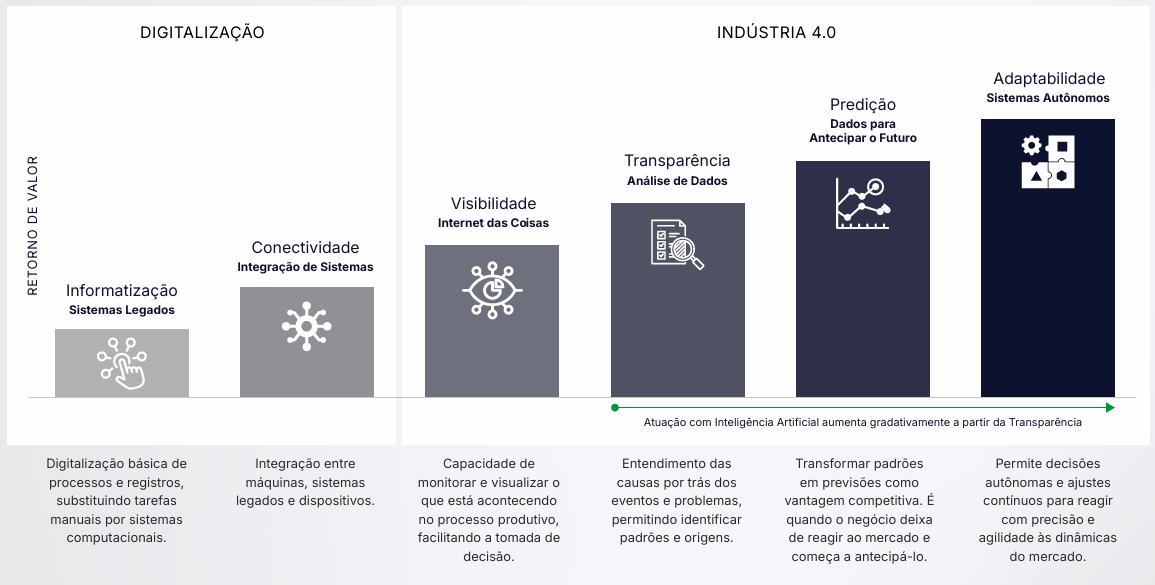
To solve this, the report adapted the German Acatech maturity model — widely used in industrial policy contexts — into a clear, visual framework for Brazilian readers. The six stages move from Computerization (legacy systems replacing manual tasks) through Connectivity, Visibility (IoT monitoring), Transparency (data analysis), Prediction, and finally Adaptability (autonomous systems). The critical insight is that AI's role increases progressively from Transparency onward — and that most Brazilian industry in these regions is still in the early stages, which means the opportunity for quick, high-ROI gains with IoT and Edge AI is real and immediate.
This framework became the conceptual backbone of the regional recommendations. Every productive chain, every regional profile, every technology suggestion in the report connects back to it.
The 15 regions: profiles, not just data
The final selection — Aracaju, Belém, Cajazeiras, Campina Grande, Cuiabá/Várzea Grande, Goiânia, João Pessoa, Juazeiro do Norte (Cariri), Maceió, Palmas, Patos, Petrolina/Juazeiro, Santarém, São Luís, and Sobral — was profiled individually with economic and industrial data, main productive chains, institutional ecosystem, and specific technology opportunities.
Each profile was designed to be actionable: not a summary of what the region is, but a map of where technology can generate the fastest and highest-value impact. The productive chains in these regions — food processing, agribusiness, construction materials, textiles, chemicals — share a common characteristic: they operate largely without automation, without IoT instrumentation, and without predictive systems. The gap between current maturity and what embedded sensors, edge AI, and industrial connectivity could deliver is large. That gap is the opportunity.
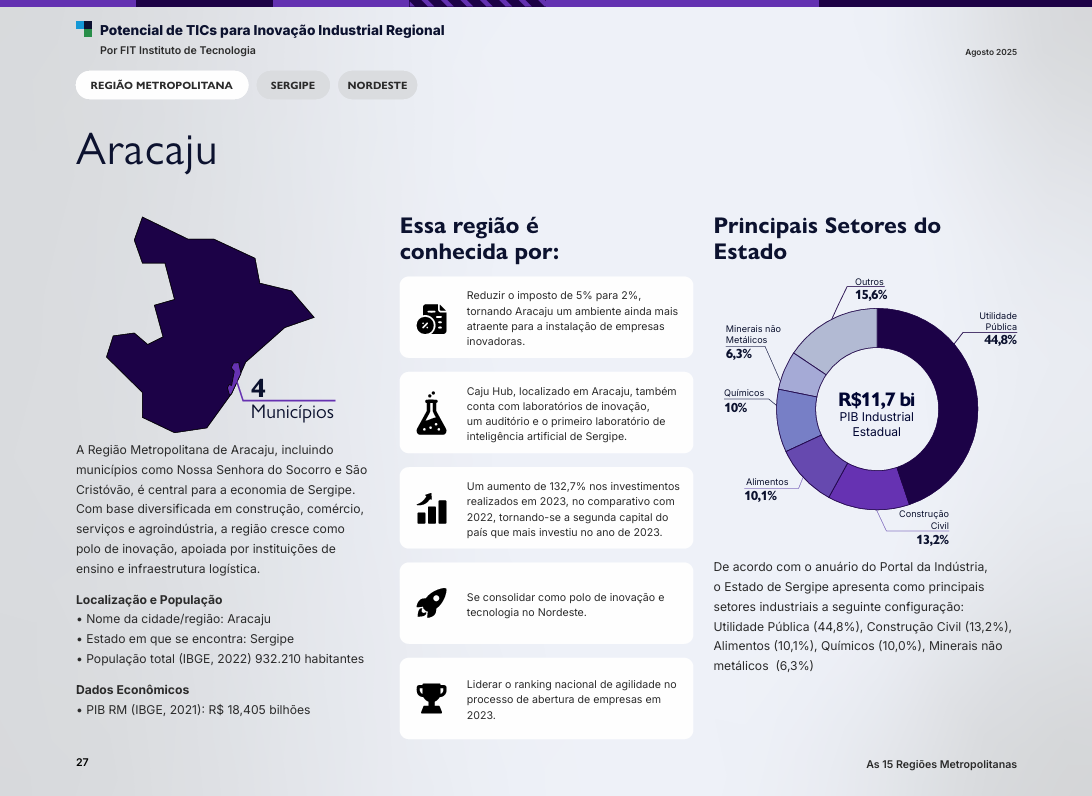
Aracaju, for instance, recorded a 132.7% increase in investment in 2023 versus 2022, ranked first nationally in speed of business registration, and hosts the first AI laboratory in Sergipe — all signs of a region in active transition. Its industrial GDP reaches R$11.7 billion, with Utilities (44.8%), Civil Construction (13.2%), Food (10.1%), and Chemicals (10%) as the leading sectors.
The editorial and design work
A 65-page strategic report has two failure modes: it becomes so dense that only specialists read it, or it becomes so simplified that it loses credibility with technical audiences. The editorial work was to find the path between them.
As Lead Designer and Editor, the work involved more than layout. It meant deciding the reading sequence — what an executive should understand in the first five pages, what a regional partner needs on page 30, what a technical team needs in the appendix. It meant designing data visualizations that make a scoring methodology legible without requiring the reader to understand the underlying statistical model. It meant writing transitions that connect macroeconomic context to regional specifics without losing the thread.
The visual identity follows FIT's institutional language — dark navy, structured green, geometric patterns — applied consistently across 65 pages of varying content density: from full-bleed cover spreads to dense comparative matrices. The result is a document that reads as a single authored voice, not as a collection of research fragments.
What this report is for
The report was published in August 2025 to support the strategic direction of the PNAAT — Programa Nacional de Aprendizado Acelerado em Tecnologia — and inform partnerships with industrial federations, universities, companies, and government across the 15 selected regions.
Its core argument is not about charity or inclusion. It is about economic intelligence. Developing these regions is not just an act of redistribution — it is a bet that the next industrial productivity gains in Brazil will come from places that still have significant headroom to absorb technology. The regions that become hubs now will define the industrial map of the country a decade from now.
The report makes that case with data. That was the job.
Start a conversation
Have a problem worth solving?
If this kind of work fits what you are building, let us talk it through.
Dual open innovation program connecting industry and universities, designed to find talent, solve real business problems, and build a lasting innovation culture.