
Innovation Funding in Brazil: Where the Money Goes and Which Route to Investigate First
Companies develop products, processes, and technologies without realizing that part of this effort may find support through innovation-funding mechanisms. The opportunity exists, but the path is rarely obvious. Between acronyms, laws, calls for proposals, agencies, and reporting requirements, many people give up before learning whether their project could fit. This is a starting map: where the money comes from, how it moves, who participates, and which instruments may make sense in each situation.
How it works at its core
Funding is a way to share innovation risk. The government may give up part of its tax revenue, lend resources under specific conditions, transfer money through a call, or co-fund a project with a research institution. In return, it requires compliance with the rules, documented execution, and results consistent with the plan.
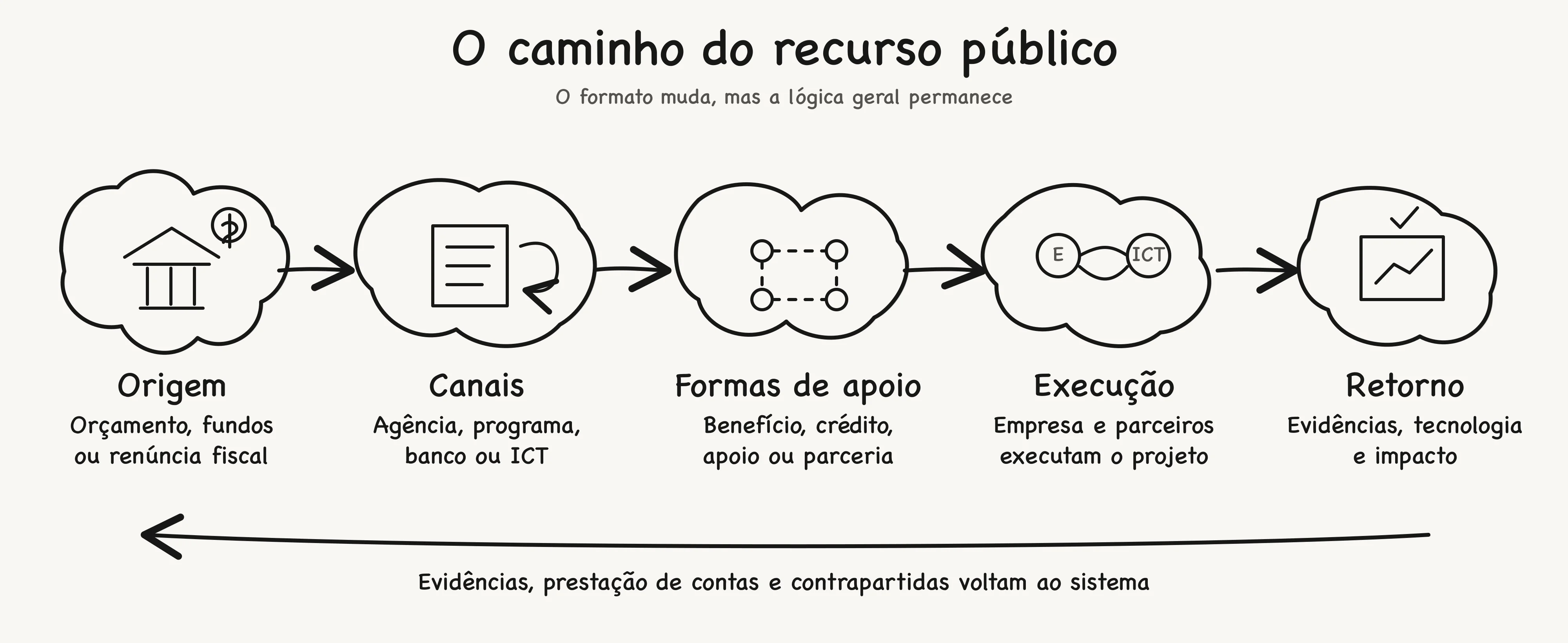
The money can originate in the public budget, funds such as FNDCT, a credit policy, or a tax incentive. FAPESP adds resources from the State of São Paulo. From there, it goes through an agency, program, bank, or ICT before reaching the project. In some cases it enters the company’s account; in others it pays the partner institution or appears as a tax reduction.
There is also a return flow. The company delivers reports, financial records, and technical results and, depending on the instrument, taxes, installments, or matching funds. A project can fail technically and still produce valid knowledge. What cannot fail is traceability: what was done and what was spent must be clear.
Who participates
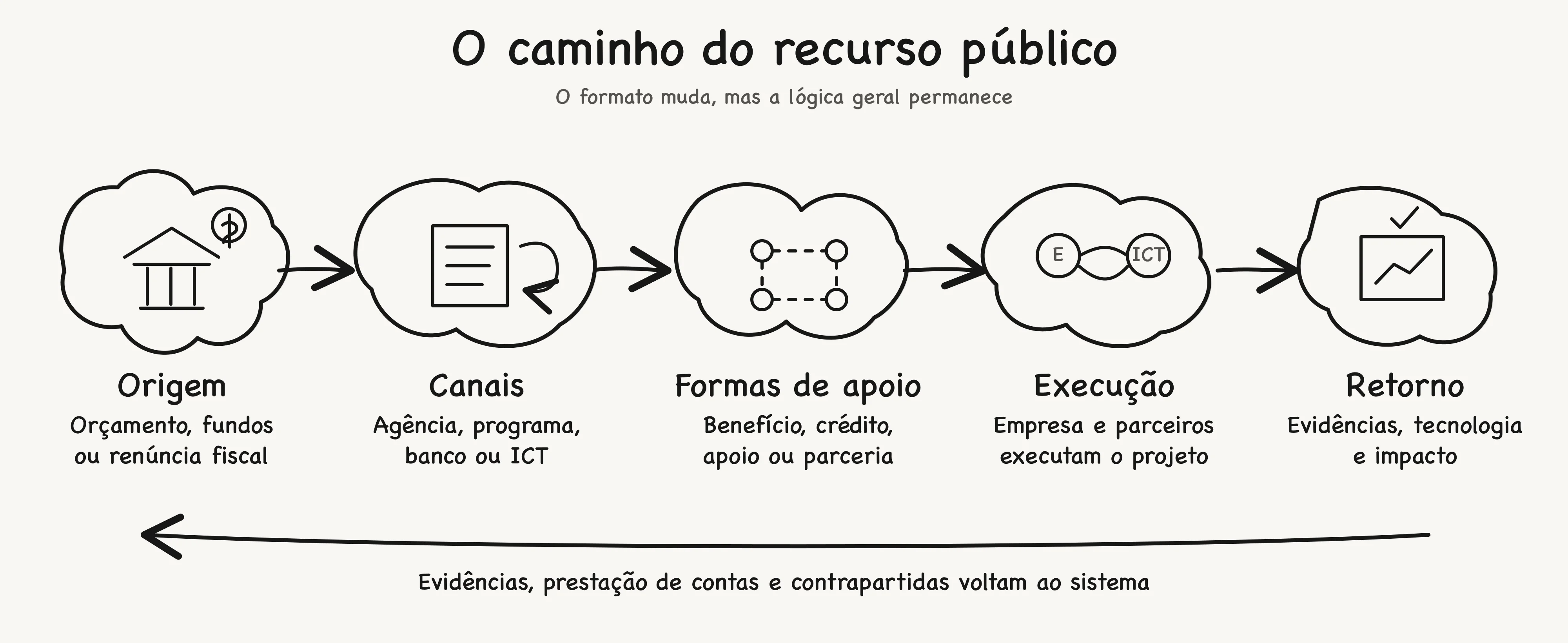
The company, including a startup, owns the problem and keeps the business decision. A startup is not an ICT: it plays the business role, even when it began as a university spin-off or develops the project with an ICT. The agency sets the rules and follows the resources. The ICT performs research, testing, or development; its technology-transfer office handles intellectual property and transfer.
Finance, accounting, and legal teams turn the technical plan into a budget, contract, and evidence. The arrangement changes according to the program. Under PIPE, a small business may receive direct support for research. Under PITE, a company and research institution cooperate. Under EMBRAPII, companies, including startups, develop projects with accredited ICTs. Who applies, receives the funds, and provides matching funds depends on each program’s rules.
The main routes
Lei do Bem reduces the cost of R&D already carried out by companies under Brazil’s Actual Profit tax regime, provided they are tax-compliant and keep technical and accounting records. It is worth investigating when the company already invests in R&D on a recurring basis.
Lei de TICs grants financial credit to accredited ICT-product manufacturers that meet the Basic Production Process and R&D-investment requirements. EMBRAPII co-funds projects negotiated with an accredited Unit, giving companies access to its team and infrastructure when specialist competence, a laboratory, or a technical partner is needed.
Finep offers different doors, especially credit and non-reimbursable support, each with its own assessment, contract, and reporting. In São Paulo, FAPESP’s PIPE supports research in small companies, while PITE co-funds research conducted by a São Paulo ICT in cooperation with a company. FAPESP is not a federal instrument, but it is a relevant route for companies and ICTs in the state.
Sector policies such as Brasil Semicon, Mover, and Redata deserve an extra check when the project belongs to those value chains. They do not change the basic map, but can change the opportunity available to a specific case.
How to choose a first route
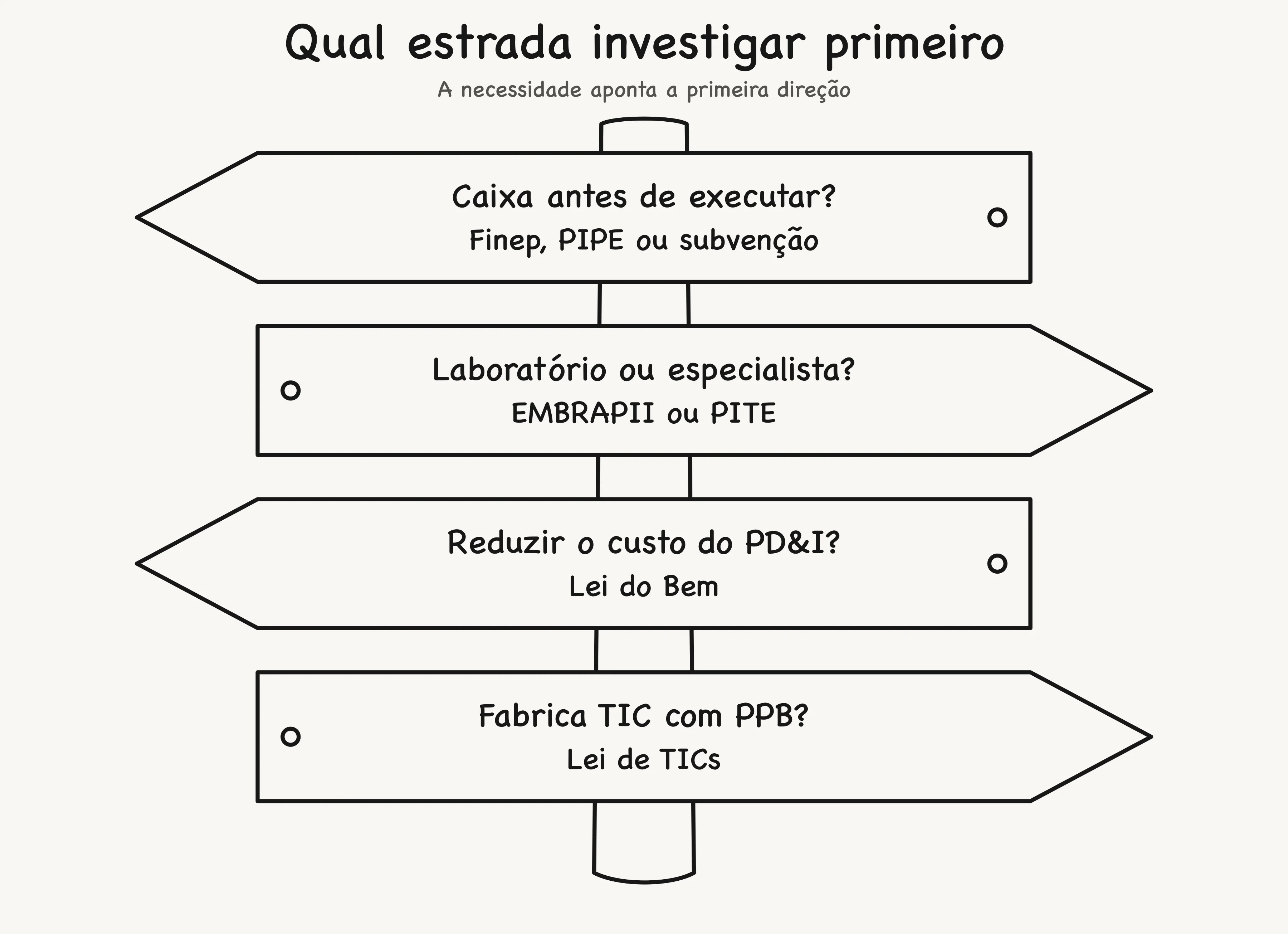
Start with the project’s need, not with a program’s name. If the goal is to reduce the cost of recurring R&D, look at Lei do Bem and confirm the tax regime, taxable profit, and evidence per project. If you need a lab or specialists, begin with EMBRAPII or PITE and confirm partner competence, matching funds, and intellectual-property terms.
If you need cash for an innovation plan, investigate Finep credit and check repayment capacity, guarantees, and eligible items. If you need to share risk without creating debt, assess Finep’s non-reimbursable support, PIPE, or EMBRAPII according to the call, company size, geography, merit, and matching funds. For an ICT industrial-policy obligation, start with Lei de TICs and confirm the product, PPB, accreditation, and R&D plan.
It is common to arrive at two complementary routes. A project may use an EMBRAPII Unit for proof of concept, Finep credit for a pilot line, and Lei do Bem on the eligible share paid by the company. The combination requires separate funding sources, activities, and expenses. The same invoice cannot finance two stories at once.
Practical tips before applying
Start with the technical challenge. State what is still unknown, how it will be tested, and which result will enable a decision. Separate research from implementation: installing a known technology can be necessary, but it does not become R&D simply because it took effort.
Read disqualifying criteria before writing a proposal. Tax regime, company size, territory, sector, and type of expense often settle the question early. Choose an ICT for proven competence, not only proximity or an old relationship. Negotiate intellectual property before the work starts: ownership, licensing, exclusivity, publication, and future use must fit the business model.
Make evidence part of the project from day one. Hours, versions, tests, decisions, invoices, and payments are more reliable when recorded during execution. Build a budget by activity and funding source. It reduces rework and prevents the same expense from being claimed under two instruments. Finally, confirm rules and deadlines on official websites: calls close, rates change, and programs gain new conditions.
The useful question
The goal of this map is not to memorize acronyms. It is to recognize the kind of help the project needs. Lei do Bem and Lei de TICs reduce costs under specific conditions. Finep can provide credit or non-reimbursable resources. EMBRAPII brings companies closer to technological competence. FAPESP creates research paths in São Paulo.
The useful question stops being “which call is open?” and becomes: “which risk do we need to reduce, which resource is missing, and what evidence will we be able to produce?” With that answer, the universe of options shrinks and the conversation with an agency, ICT, or accounting team starts from a much better place.